Thursday, January 27, 2022

Documenting, sharing and amplifying learning

Today was my first PYPC Book club - and how lovely it was to see some familiar faces there!  Of course an hour is never really long enough, but it was the motivation I needed to read further in the book A Guide to Documenting Learning.  After the book club, I started to read chapter 5 and to think about sharing and amplifying and how this can link to action research.  

I thought back to when I started writing a blog in 2009 - I also reflected on the "whys" of this.  I know at the time this was not a popular decision in my school for a number of reasons:  blogging was new so lots of people were wondering why I wanted to do this; also as I reflected on my practice I shared not just my successes but also my struggles - this wasn't seen in too good a light by the school admin who felt this could reflect poorly on the school (I then went back and removed all references that might identify me and the school including the country I was living in - but of course it's hard to be completely anonymous as there are many ways people can "find" me online).  Finally I was accused of personal branding by one member of the admin, even though at that time I didn't have my own domain name and was simply blogging under the words Tech Transformation.  I'm glad I persisted though - for one thing I got to meet Silvia!

Certainly I can say that sharing led me to becoming a better educator - as the sharing involved a lot of reflection and decision making about what I wanted to share.  As Silvia writes, "sharing and amplifying is about making one's learning visible to others with purpose and meaning."  Also, as I found out when I actually did some action research with Silvia's school, it's about inviting others into the learning process.

There's a difference between sharing and amplification.  For example when I first started blogging I did it just for me.  I was the only audience of my posts.  They were online and anyone could have read them, but how on earth would they find them?  Fortunately right at the start of this process I joined a blogging alliance and committed to reading and commenting on the posts of other bloggers in the group (there were 50 of us).  This was the first time I started to interact with educators that I had never actually met.  Of course, writing for myself had its benefits as it helped me make sense of what I was doing and reading and reflecting on this took the learning out of my head.  At the start, I was also involved in a face to face professional book group across 3 local schools that met in the pub in the evenings.  That dialogue was useful as well.  Amplifying the learning goes beyond this however - it can be meeting people we don't know in a conference or using a virtual platform - and this has the ability to further stretch our thinking as we need to consider many new perspectives.  Also presenting your work to an audience that is unfamiliar means you tend to produce higher quality thinking as it's a risk to "put yourself out there".  For me, because putting yourself out there was frowned on by my school, I initially avoided Twitter and linking back to my blog.  Later on, however I was enthusiastic about joining in the #pypchat, which increased my personal learning network, and more recently I have joined several Facebook groups all associated with education.  Publishing on my blog is also a way of documenting my own learning journey, and it still amazes me that that some posts that I wrote years and years ago continue to be read over and over.

Here's the interesting thing from this chapter however:  sharing globally cannot include only sharing in one's mother tongue or with people who speak your own language or who come from your own cultural perspective.  You must do more than simply put your artefacts and learning journey online - you also have to include a purposeful global intention because deeper learning takes place when you welcome different viewpoints and perspectives.  So for me this is raising even more questions - and the most important of these is how?

Photo Credit:  Gerd Altmann on Pixabay

Monday, January 24, 2022

Documenting both the students' and the teachers' learning


I'm reading through Chapter 4 of A Guide to Documenting Learning and getting ready to join in with the PYPC Bookclub discussion next week.  The focus here is on documentation of learning for both students and teachers.  

  • Students can document their own learning and be engaged in metacognitive processes when looking for and capturing evidence of learning.
  • Teachers can also document the students' learning and share the artefacts with them so that they can reflect on their own learning.
  • Teachers can also document their own professional learning.
  • When students share their own documentation with the teacher this can also help the teacher learn, through seeing the perspective of the student.  The teacher gains insight in how the students' understanding is progressing and can help the teacher decide where students need further support.
Students can collect, curate and make their learning visible using a variety of platforms and tools.  Teachers can document their learning in a way that makes their classrooms "action labs" - this reinforces the idea of teachers also being lifelong learners.  Such artefacts can also be used as part of a teacher observation cycle.  

A school can also share the learning that is taking place there.  I remember being part of ASB's R&D team where we published our findings and shared them on our blog.  In this way we were able to show our school community and the wider educational community what we believed and valued as a school.

Photo Credit:  Gerd Altmann on Pixabay
The difference between displaying and documenting learning


In the Assessment section of PYP: Principles into Practice, documenting learning is described in the following way:

Documenting learning is the compilation of the evidence of learning. Documentation can be physical or digital and can be displayed or recorded in a variety of media forms. Documentation of learning is shared with others to make learning visible and apparent.

I was therefore interested to read in Silvia Tolisano and Janet Hale's book A Guide to Documenting Learning that by default documentation is not pedagogical.  They go on to describe how to be considered pedagogical documentation, the action must facilitate learning.   For example a teacher taking photographs of student work is not enough - the photos need to be used in a strategic way to inform students on how they are doing and the progress they are making towards a learning goal.  For example teachers could annotate the photos to help students reflect on their learning or they could share a series of photographs to help students understand their learning growth.

They also describe heutagogical documentation which is learner driven and focuses on self-motivated and self-directed learning.  This documentation can also fuel the motivation to learn and to make decisions about next steps in learning.  The aim here is to support learners to become more independent and self-determined.  The work of Daniel Pink (autonomy, mastery and purpose) also addresses motivation - he defines autonomy as being free from external control or influence, for example not doing something just to receive a grade.  This links in nicely with the PYP emphasis on student agency.  Mastery is also seen as important because it means you have the desire to improve.  Learners who are motivated will naturally investigate, research and apply what they learn to improve their understanding.  Documentation that provides evidence of learning over time can be a way of motivating self-directed learners to pursue mastery.  Finally purpose is important in motivation.  Sharing learning can be very motivating and exciting for students - they are more excited and involved when they are producing content and when connecting with local and global learning communities.

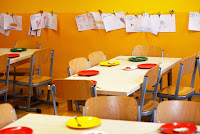
Often when I go to visit schools I see elaborate and beautiful displays in the classrooms and corridors.  Displaying work does make it visible to an audience, however what is displayed may or may not be noticed, and the displays may also not convey students' thinking.  Silvia writes:

Displaying is documenting without a specific purpose or goal being captured during the learning process over time.

However displaying work can be motivating for some students as they know that others see their work and they are sharing their learning with a larger audience.   Silvia challenges us to:

Fight the urge to merely display snapshots of what was done or final products, and convert display items into documentation artefacts by making the process of thinking and learning visible and meaningful.

Photo Credit:  Katrina S on Pixabay 

Friday, January 21, 2022

How documenting learning can support literacy

I've moved onto Chapter 2 now in the PYPC Bookclub where we are reading about what Silvia refers to as the Now Literacies.  She writes that the point of education is to become literate and that the ability to read, write and communicate thoughts and ideas in many different ways helps us to be a productive contributor to society.  We know that documenting learning enables thoughts and ideas to move from mental thinking to shareable thinking through the use of text and images.  This helps to connect thoughts, reflections and events that might otherwise be isolated, into something that makes meaning of the learning journey by showing patterns, trends and timelines in the learning.

Documenting learning can also support media literacy - the understanding and creating of visual messages.  Silvia points out that visual images can be "read" for comprehension (meaning making) and inferencing (interpreting and negotiating meaning).  Documenting learning is connected to media literacy because the documentation process involves making learning visible to the learner and others.  It's important to note that media literacy is not just about reading, writing and creating media - it's also about interpreting, analysing, evaluation and making meaning of the media - and can be tied in with an understanding of digital citizenship.

In PYP schools we also talk about international mindedness.  Documenting learning can support global literacy:  global competence is defined as the toolkit a productive, involved citizenry use to meet the problems and opportunities of the world.  Global competence challenges students to investigate the world, consider a variety of perspectives, communicate ideas and take meaningful action.  A curious, inspired student strives to learn more in school and beyond.  Local and global inquirers will consider multiple perspectives.  Since global refers to somewhere outside of one's locality, students can learn a lot by connecting with others living elsewhere (another city, state or country).  This also helps students come to the conclusion that people are more similar than different - so promoting the understanding of human commonalities, and in the words of the IB mission statement that "others with their differences can also be right".  

Embracing the "new" or "now" literacies and using these to document learning will help both students and teachers to become both consumers and producers of media.

Photo Credit:  Gerd Altmann on Pixabay
Wednesday, January 19, 2022

Evidencing and documenting learning

 I have joined the PYPC Bookclub and our first book is one that I was given personally by one of the authors who told me that I need to document my journey from teacher to consultant.  The book is A Guide to Documenting Learning: Making Thinking Visible, Meaningful, Shareable, and Amplified by Silvia Rosenthal Tolisano and Janet Hale.  I decided that Silvia would have loved it if I'd blogged about my reading and learning from her book, so I'm using this blog to take notes on my reading before our first meeting.  There are likely to be a number of blog posts about this book, not least because I frequently lead the Evidencing Learning PYP workshop for the IB and because I think so much of what I'm reading about can be useful to me as a workshop leader, as well as for my participants.  So here we go with my important take-aways from Chapter 1:

  • Documenting means more than being organised or supporting learning by providing evidence.  It involves accessing and reflecting on one's own learning process and articulating what is taking place through the learning journey.
  • While anyone can document a moment in time by recording a video, taking a picture or writing down verbatim what is being said, documenting learning needs to be strategic and purposeful.
  • Skills need to be developed to aid learners in understanding how media tools and platforms aid in capturing and sharing learning, as well as how media choices affect one's ability to demonstrate thinking and learning visible and/or auditorily.
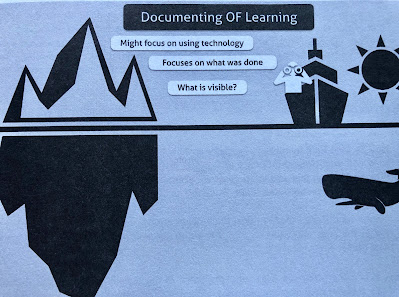
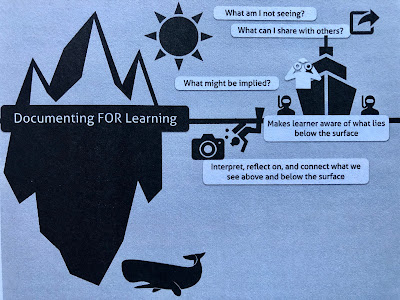
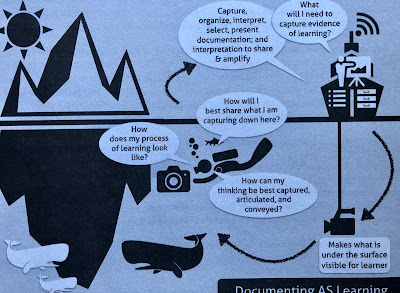
Documenting learning types (the iceberg)

Documenting OF Learning

Documenting of learning uses documenting as a snapshot product or performance artefacts that display learning moments.  Documenting of learning is often overused.  Learners recored everything and anything without necessarily interpreting what has been captured.  Documenting of learning focuses on the product and the artefacts are observable, visible and/or audible to an onlooker.  They are simply captured moments in time, whether shared in person, digitally or on social media.  Documenting of learning is the visible portion of the iceberg that is above the water.  When done at this surface level, documentation often feels like extra work for students and teachers, who see no real benefit or purpose beyond compliance.

Documenting FOR Learning

This uses interpretations of purposefully selected artefacts to convey evidence of meaningful visible and audible moments that take place during or because of the learning process.  It is designed to raise awareness of a learner's changes, trends or patterns over time.  Documenting for learning goes beyond simply capturing evidence of learning by digging deeper into the interpretation and application of what the artefacts convey.  There are two types:

  • Documentation for one's own learning purpose to track progress over time.
  • Documentation wherein a learner makes his/her thinking and learning visible in order to help others learn when it is shared.
Since documenting for learning asks learners to interpret, reflect on and connect artefacts along a learning journey, this type of documentation often makes visible that which learners are not even aware of and provides time to interact with and examine artefacts to make connections and discover patterns and trends.  Documenting for learning is the waterline connecting the visible to the invisible.  It is in this space that hidden or implicit learning is cognitively explored, explained and expressed.  


Students and teachers express that this type of learning opportunity is authentic and worthwhile, especially when they can share their learning process with others.  contributing to a community of learners deepens one's understanding, meaning and purpose.

Documenting AS Learning

Documenting as learning takes the process to an even deeper depth wherein the documenting process becomes a critical facet of the learning journey.  It focuses on the learning journey and there is a deeper level of critical thinking and metacognition involved when someone needs to make choices about what best portrays evidence of learning.  When documenting moves from being a product or cognitive tool to a metacognitive process, it enters the depths wherein the iceberg is totally hidden beneath the surface.  It is about the actions and metacognitive thinking taking place while the learning is happening.  It is about exploring the what and how below the visible surface that aids learners immediately and over time.  It also invites and engages others to join in the learning process through sharing and obtaining feedback.


While documenting OF learning is a valid place to begin purposeful documentation, moving to documenting FOR learning makes thinking about one's learning visible and/or audible, which leads to an awareness of what is involved in the learning process.  Documenting AS learning adds a subtle, yet powerful, layer of metacognition that engages learners in determining how to best capture the learning process.