Showing posts with label Assessment. Show all posts

Wednesday, January 19, 2022

Evidencing and documenting learning

 I have joined the PYPC Bookclub and our first book is one that I was given personally by one of the authors who told me that I need to document my journey from teacher to consultant.  The book is A Guide to Documenting Learning: Making Thinking Visible, Meaningful, Shareable, and Amplified by Silvia Rosenthal Tolisano and Janet Hale.  I decided that Silvia would have loved it if I'd blogged about my reading and learning from her book, so I'm using this blog to take notes on my reading before our first meeting.  There are likely to be a number of blog posts about this book, not least because I frequently lead the Evidencing Learning PYP workshop for the IB and because I think so much of what I'm reading about can be useful to me as a workshop leader, as well as for my participants.  So here we go with my important take-aways from Chapter 1:

  • Documenting means more than being organised or supporting learning by providing evidence.  It involves accessing and reflecting on one's own learning process and articulating what is taking place through the learning journey.
  • While anyone can document a moment in time by recording a video, taking a picture or writing down verbatim what is being said, documenting learning needs to be strategic and purposeful.
  • Skills need to be developed to aid learners in understanding how media tools and platforms aid in capturing and sharing learning, as well as how media choices affect one's ability to demonstrate thinking and learning visible and/or auditorily.
Documenting learning types (the iceberg)

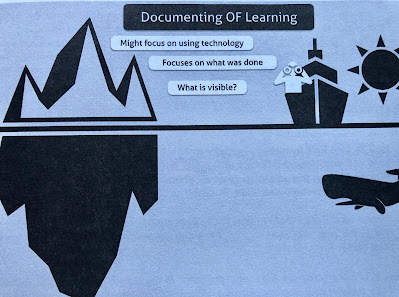
Documenting OF Learning

Documenting of learning uses documenting as a snapshot product or performance artefacts that display learning moments.  Documenting of learning is often overused.  Learners recored everything and anything without necessarily interpreting what has been captured.  Documenting of learning focuses on the product and the artefacts are observable, visible and/or audible to an onlooker.  They are simply captured moments in time, whether shared in person, digitally or on social media.  Documenting of learning is the visible portion of the iceberg that is above the water.  When done at this surface level, documentation often feels like extra work for students and teachers, who see no real benefit or purpose beyond compliance.

Documenting FOR Learning

This uses interpretations of purposefully selected artefacts to convey evidence of meaningful visible and audible moments that take place during or because of the learning process.  It is designed to raise awareness of a learner's changes, trends or patterns over time.  Documenting for learning goes beyond simply capturing evidence of learning by digging deeper into the interpretation and application of what the artefacts convey.  There are two types:

  • Documentation for one's own learning purpose to track progress over time.
  • Documentation wherein a learner makes his/her thinking and learning visible in order to help others learn when it is shared.
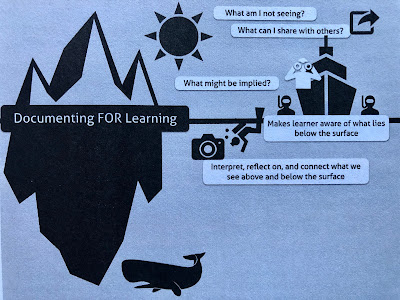
Since documenting for learning asks learners to interpret, reflect on and connect artefacts along a learning journey, this type of documentation often makes visible that which learners are not even aware of and provides time to interact with and examine artefacts to make connections and discover patterns and trends.  Documenting for learning is the waterline connecting the visible to the invisible.  It is in this space that hidden or implicit learning is cognitively explored, explained and expressed.  


Students and teachers express that this type of learning opportunity is authentic and worthwhile, especially when they can share their learning process with others.  contributing to a community of learners deepens one's understanding, meaning and purpose.

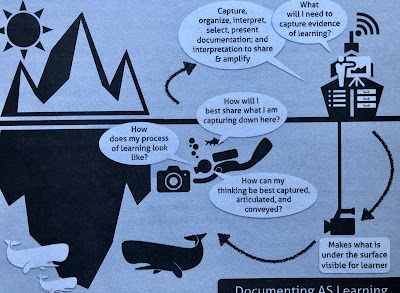
Documenting AS Learning

Documenting as learning takes the process to an even deeper depth wherein the documenting process becomes a critical facet of the learning journey.  It focuses on the learning journey and there is a deeper level of critical thinking and metacognition involved when someone needs to make choices about what best portrays evidence of learning.  When documenting moves from being a product or cognitive tool to a metacognitive process, it enters the depths wherein the iceberg is totally hidden beneath the surface.  It is about the actions and metacognitive thinking taking place while the learning is happening.  It is about exploring the what and how below the visible surface that aids learners immediately and over time.  It also invites and engages others to join in the learning process through sharing and obtaining feedback.


While documenting OF learning is a valid place to begin purposeful documentation, moving to documenting FOR learning makes thinking about one's learning visible and/or audible, which leads to an awareness of what is involved in the learning process.  Documenting AS learning adds a subtle, yet powerful, layer of metacognition that engages learners in determining how to best capture the learning process.

Tuesday, June 9, 2020

What's new and different: Assessment in the PYP

This is almost my final post about what is truly new and different in the Enhanced PYP.  I still want to do a post about the Exhibition, and beyond that will start to explore the areas of the Enhancements that are more of a deeper focus or where there is more guidance.  This post is going to deal with assessment and there are quite a few important differences in the Enhanced PYP - so this could be quite a long post.

For me I think one of the most important differences is the shift away from the summative assessment, which used to be required at the end of each unit of inquiry.  So important was this summative, that it was generally discussed by teachers in very the first collaborative planning meeting, as it was in the first box of the planner.  Traditionally the teacher was the assessor.  Now assessment is built in throughout the planner, it involves evidencing the learning by the students themselves as well as peers and teachers, and it is ongoing, made up for formative and summative.  There is no longer any requirement to have a summative assessment at the end of every unit, as the process of gathering, analysing, reflecting and acting on evidence of learning is what is used to inform next steps in teaching, a process now known as feed forward.  Because of this, both students and teachers need to develop their assessment capability, to consider the learning goals and success criteria and to focus on assessing both the learning process as well as the learning outcomes.

The fundamental purpose of all assessment is to gather and analyse information to inform teaching and learning through an understanding of where the student is at any given point in time.  Throughout the learning process, it identifies what students know, understand and can do.  This backward and forward-looking approach uses feedback to help students to know what they need to learn next.

The whole learning community should be involved in assessment:  students become more effective learners when they are actively engaged in assessment and when they can reflect on their progress, set their own goals, and act on constructive feedback.  Teachers become more effective when they reflect on their practice and adjust their teaching based on the evidence of learning and when they support students to become assessment capable.  Parents also become more supporting partners when they understand the learning goals.  Schools as a whole develop as learning communities when they use the assessment data to evaluate both the depth of the curriculum and the effectiveness of teaching.

In PYP: From Principles into Practice there are a list of the characteristics of effective assessment:
  • Authentic - connected to the real world
  • Clear and specific learning goals and success criteria
  • Varied - using a wide range of tools and strategies
  • Developmental - focused on an individual student's progress and not on their performance in relation to others
  • Collaborative - involving both teachers and students
  • Interactive - with ongoing dialogues about learning
  • Feedback to feedforward - where feedback is used to inform future learning.
Assessment in the Enhanced PYP has much more emphasis on student self-assessment, where students review and evaluate their knowledge, understanding and skills.  When students are able to do this, they become more responsible for their learning as they are able to incorporate feedback, plan, make corrections, and implement improvements in their learning.  Ultimately students are able to reset their own learning goals as they know where they are going in their learning and can consider what they need to do to get there.

To help students become more assessment capable, success criteria should be co-constructed.  Students need an understanding of what quality work looks like, they need to know how to incorporate feedforward into their learning, they need time to reflect and they need practice with both self-assessment and peer-assessment.

As mentioned earlier, traditionally assessment was a backwards by design process where teachers designed the summative assessment right at the start of the units by identifying what they wanted students to know, understand and do.  They often stared with designing the summative assessment and then worked backwards to plan the learning engagements to ensure that students would have the understanding, knowledge and skills to be successful in the summative.  In the Enhanced PYP there is also the term "forward by design" which supports the development of the learner profile and approaches to learning and "soft" skills that cannot easily be measured - and as a result the learning process is valued as much as the learning outcomes.

One huge change in the Enhancements is the Four Dimensions of Assessment:  teachers monitor, document, measure and report on learning using an integrated, ongoing process.   These four dimensions are not equal - in fact the PYP chooses to put the emphasis on monitoring and documenting the learning as these are critical in providing actionable feedback for the learner.
  • Monitoring learning - happens daily in every lesson.  It involves observation, questioning and reflection with a view to checking the progress of learning against students' personal learning goals and success criteria.
  • Documenting learning - this is the evidence of learning and can be physical or digital, including checklists, rubrics, learning journals, learning stories and portfolios.  This documentation is hared with others to make learning visible and apparent.
  • Measuring learning - captures what a student has learned at a particular point in time.  It's important to note that not all learning can be or needs to be measured.
  • Reporting on learning - gives clear information about learning to students and parents.
Finally a little word about feedback.  We know from the work of John Hattie that feedback is one of the most effective teaching practices, and should therefore form the core of assessment.  Feedback provides an opportunity for reflection and action and it promotes continuous improvement and celebrates success.  We also know from the work of Dylan Wiliam that "formative peer assessment, where students are helping each other improve their work, has benefits for the person that receives feedback but also has benefits for the person who gives the feedback."  Peer feedback is important because it is done in the context of relationships and is given in language that students naturally use.  It has also been observed that students are more ready to accept feedback from one another, and in giving and receiving feedback as part of the inquiry process, students increase their assessment capability.

Photo Credit: Ken Whytock Flickr via Compfight cc

Monday, May 18, 2020

Designing engaging and rigorous learning experiences

Yesterday I led an online workshop for Toddle at the Inquiry Educators Summit (TIES).  It was amazing, even though there was a Zoom outage in the UK and eastern USA during the time of my presentation.  Thanks to the amazing support in India, I was still able to deliver my presentation - and it was really odd because I could not see either my slides or the audience.  Although my intention is to provide a fuller account of this workshop, including a downloadable resource that Toddle can add to their Learning Library, I'm going to give a few brief reflections here.  First of all here were the intentions of the workshop:
  • Learn how to incorporate higher order thinking skills into student learning experiences and assessments
  • Consider how to get students to think and dive deep into their inquiries
  • Understand the importance of giving students voice, choice and ownership in how they show their understanding
I'm always amazed at the wonderful notes that participants take using sketches.  It's a really creative way of taking notes and I'd like to share a couple that were made during my presentation and then shared on Twitter.  Obviously Sketchnotes done live over an hour's presentation cannot cover everything, but for me looking at these later it was interesting to see the main points that were seen as important during my session.  This first one is from Lucy Elliott, a PYP Coordinator in China.


Looking at this one I can see the message that comes up clearly is that teachers are the designers of learning.  I can see references to Bloom's taxonomy and the importance of designing so that students are using higher level thinking skills.  In particular that creating involves new and original work/thinking.  I can also see the reference to the SAMR model.  Again I see lots of verbs being used to provoke higher level thinking and reference to the importance of asking open-ended questions.

This one is from Shailja Datt, a PYP Coordinator in India.  This also mentions Bloom's and the SAMR models, and the verbs that can raise thinking.  This one also includes the other "R"s that I feel are important:  rigour, redefining the task and return on learning.


I'm very grateful to both these that were shared on Twitter as it helps me to reflect on my presentation.  I hope to receive the chat (which I also couldn't see) later and at that point I will write a blog post to answer any outstanding questions.

Wednesday, April 18, 2018

Global competence

I've been thinking a lot about cultural competence, especially as I've been in a book group that has been reading The Culture Map.  Today I came across an article by Andreas Schleicher, the Director of Education and Skills at the OECD who has been writing about how to assess global competence.  He starts his article with a reference to the 193 countries that adopted the UN Sustainable Development Goals in 2015, pointing out that the goals will only be fulfilled if we are addressing these issues with today's students.

One of the SDGs is about quality education for all, and this goal also emphasises the need to learn to live together sustainably.  As a result the PISA test is now including global competence as something it will measure this year.  There are several components to this:
  • examining issues of local, global and cultural significance - combining disciplinary knowledge to ask questions, analyse data and arguments.  This also involves students being able to critically evaluate messages being posted on the media as well as being able to create media content themselves.
  • understanding and appreciating others' perspectives - being able to see issues from multiple viewpoints.  This should encourage respect for others and mean students are less likely to tolerate injustice, hold prejudices and subscribe to stereotyping.
  • appropriate engagement across cultures - being able to adapt one's behaviour to interact with others from different cultures and to communicate in a respectful way.  
  • being active and responsible members of society - creating opportunities to take informed and reflecting action and to make their voices heard.
So how can teachers help students to succeed in global competencies?  The first thing that struck me is how closely this aligns to international mindedness and the IB learner profile attributes.  Schools can certainly provide opportunities for students to look at issues that have local and global significance as well as being relevant to their own personal lives.  The internet and social media can be important tools for students to use in this respect.  The important thing is that global competency is not an additional "subject" like literacy and maths, it should be integrated into all areas of the curriculum.

How will global competency be tested?  This year there will be a 2-part assessment which will include a critical analysis of news articles about global issues and perspectives, communicating with others and identifying actions that will address global issues.  The other part will be a questionnaire about familiarity with global issues and attitudes.  The OECD believes the data from these assessments will provide the global community with the information it needs to build a more peaceful, equitable and sustainable world through education.  Although measuring attitudes is not easy, hopefully the new PISA assessments will at least form the start of a global dialogue about what is needed for the future, and the role that education can play in sustainable development.

Photo Credit: wilmack Flickr via Compfight cc

Thursday, November 2, 2017

Assessments, testing and grading

Over the years I've read a lot about grades, including various books and articles by Alfie Kohn who sees all grades (even the high ones) as being ultimately demotivating for students.  I have lots of ideas about grading myself, so I was curious to read the chapter Assessment for a Growth Mindset, in Jo Boaler's book Mathematical Mindsets.  Obviously Jo is focused on testing and grading in maths, but what she writes can be applied across all subjects:  grading leads students to identify and define themselves in terms to letters and numbers.  She writes,
In the United States, students are over-tested to a degree that is nothing short of remarkable particularly in mathematics.  For many years students have been judged by narrow, procedural mathematics questions presented with multiple-choice answers.  The knowledge needed for success on such tests is so far from the adaptable, critical, and analytical thinking needed by students in the modern world that leading employers such as Google have declared they are no longer interested in students' test performance, as it in no way predicts success in the workplace.
 She argues that maths is over-tested because it's so easy to test - and because of this teachers are also limited to teaching narrow procedural mathematics and to giving lots of practice tests in class in order to prepare students for later success - and this generally starts with a beginning of year test.  What sort of message is this sending to our students?  And what sort of feedback to do they get?  Mostly they will get a percentage or a grade, which Jo argues is damaging to learning (because half of the students find out that they are not as good as the others).  She writes, "study after study shows that grading reduces the achievement of students".

The result of all this - that students who are graded become less motivated - can be reversed when students are given diagnostic comments instead of grades.  Jo advocates less assessments, but that the occasional assessments that are given should be accompanied with growth comments, because what we want is for students to be excited and interested about learning and when this happens they will be motivated and their achievements will increase.  She writes,
[Grades] do motivate some students - those who would probably achieve at high levels anyway - but they de-motivate the rest.  Unfortunately, the extrinsic motivation that the high-achieving students develop is not helpful in the long term ... students who develop intrinsic motivation achieve at higher levels and stay in subjects rather than drop out.
So how can we assess students that encourages a growth mindset and shows them a positive pathway towards success?  I'll be blogging about this tomorrow.

Photo Credit: edokhan Flickr via Compfight cc

Tuesday, January 31, 2017

Concept-based curriculum and instruction

I'm in a 2 day workshop with Lynn Erickson on concept-based curriculum and instruction.  For our "homework" tonight we are in groups of 9, each of us reading a chapter from Lunn's book Transitioning to Concept-Based Curriculum and Instruction.  I was happy that when we numbered off, I ended up with number 8, thus having to read Chapter 8 which is about what principals and coaches need to understand about implementing concept-based models in schools.

Now, I have to say that for over 20 years I've worked at schools that already have a concept-based curriculum - the PYP.  However I've also consulted with schools that are moving from a more traditional way of teaching as they have decided to take on the PYP.  As with any new curriculum, change is hard - and those leading the change need to consider up-front what they can do to both to avoid the stresses and failures that might be associated with change, and to sustain any changes that do take place.

In Chapter 8, Lynn writes about how to set the stage for curriculum implementation.  This falls into 3 main steps:
  1. Examining the hidden impediments to change - for example principals who do not provide the necessary support will certainly make change less likely to succeed.  Some people embrace change (the early adopters) and others are reluctant to move out of their comfort zones. Coaches and principals need to consider the different personal characteristics of their teachers to help them to successfully implement change.
  2. Setting up the learning team - some schools know they need to change because students are struggling, yet teachers in these schools may be reluctant to change because of past failures. Conversely, schools that are experiencing success may not see the need for a change towards a concept-based curriculum.   In both cases, setting up a school learning team made up of teachers and instructional coaches is important before implementation.  This team should have members that are well respected by their colleagues, have diverse perspectives and be committed to a concept-based curriculum.  It's really important that there are teachers on this team, as they are the ones dealing with the change and can help anticipate and resolve the problems, as well as help mobilise the buy-in of the rest of the teaching faculty.
  3. Shaping a shared vision - it's really important to show teachers what a concept-based curriculum looks like in practice.  The teachers who are the ones implementing the changes are often not the same ones that were part of the decision making and curriculum development process.  Many teachers who are expected to change their practices experience anxiety and fear of failure, so support, modelling and coaching are vital. 
When adopting a new curriculum teachers go through fairly predictable developmental stages:
  • Self-oriented - wondering what it is and how it will affect them
  • Task-oriented - wondering how they do it 
  • Impact - questioning how the change is working for students
Coaches need to recognise what stage their teachers are at and design differentiated job-embedded PD to address the level of concern that individual teachers have.

When adopting a concept-based curriculum it's also important to consider student assessment. Traditional assessments measure knowledge and skills, but often don't provide much data about student understanding.  Assessments will need to be redesigned in order to focus more on conceptual understanding.

I have had an absolutely brilliant time today and can't wait to get back to school tomorrow to continue the learning.

Photo Credit: Anne Davis 773 Flickr via Compfight cc

Friday, January 20, 2017

Standardized Testing and Personalized Learning

Here's an interesting thing I was reading this week:  a study by Hanushek and Woessmann has shown that improved academic scores in a country lead to improved GDP in that country.  However the academic scores measured by standardized tests are basically only science, maths and reading.  We know there are many other cognitive abilities that can also lead to success, in particular creativity, resilience and social adaptation also require cognitive ability, but these cannot be measured using standarized tests.  The premise of the study was that limiting assessments to just 3 subjects ignores a huge quantity of cognitive ability, and therefore a huge impact on GDP is not being assessed, and the call for action could be that a more holistic assessment of students' full cognitive achievements and abilities is needed by countries that want to really assess the impact on their GDP.

Standardized test scores are also not really effective in giving feedback to teachers about which curriculum and which lessons are most effective.  Since most standardized test take place once a year, it's hard to draw conclusions about which activities have produced those results.  For teachers, regular student assessments are more effective when the aim is to gather data that will guide learning and PD needs.  Parents also appreciate more timely information about their children's progress.  The best type of assessment for personalizing instruction is an electronic one where students are given more or less challenging questions based on their responses, so that the results provide a more accurate assessment of students' skills that a paper test.  In general, the conclusion that Grant and Basye come to in their book Personalized Learning: A Guide for Engaging Students with Technology is that online assessments are the most effective in helping teachers to get the support they need to truly help students using thoughtful, real-time data.

Photo Credit: The Advocacy Project Flickr via Compfight cc

Sunday, January 1, 2017

Ongoing assessment and feedback - another IB webinar


About a week before the end of school, I took part in another IB webinar, this time on assessment. The graphic above was really helpful in focusing in on the topic of this webinar and the cycle we should be going through as IB teachers.  I really wish I'd had the time to blog immediately after the webinar, since quite a lot of what was discussed has now retreated from my mind, but thankfully I did manage to jot down a few thoughts on Twitter at the time.  Here are some of the questions that emerged from this webinar:

  • Tools and strategies for assessment - are we over-relying on just one or two?  One suggestion would be to map this out to see what patterns emerge.
  • Authentic summative assessment - Could students do the assessment at the beginning, before even starting the unit? And if so, how would it look like compared with summative?
  • Impact of assessment on teaching and learning - are we designing assessments that support good teaching and learning?  And alongside this, is the feedback that we give students helping to reduce the gap between where they are now and where they need to go next.
  • Is assessment a scrapbook or a snapshot?  We need to think about more holistic ways of viewing and assessing learning, for example combining observations and dialogue along with the products that students create.
There was a great graphic shared about the stages of assessment.  Again I really like the assess - record - report cycle indicated here.  


Assessment is a really huge topic.  It has come up several times as a topic for the #pypchats on Twitter and I know that whenever I lead a Making the PYP Happen workshop it's something that the participants want to know more about.

I really love this series of webinars as it gives me the opportunity to dig a little deeper into my understanding of various aspects of the IB programmes.  I also appreciate the opportunity to learn more about the other IB programmes that I don't actually teach.  I really hope that these webinars continue in 2017.

Monday, November 21, 2016

Meaningful learning

Since the IB webinar last week, I've been reading and thinking about learning:  not just acquiring knowledge but being able to use this knowledge in a variety of new ways and situations.  One of the articles I read was by Richard E Mayer on Bloom's Revised Taxonomy.  I was interested in this because we use Bloom's Digital Taxonomy in our tech audit when discussing student work, and I wanted to dig a bit deeper - to go beyond the 6 categories.

Obviously, two important goals of education are to promote retention and to promote transfer.  Retention simply means that students remember material that was taught to them in the past, whereas transfer indicates more meaningful learning as it's the ability to use what was learned to solve new problems or to answer new questions in the future. Teachers traditionally teach for retention, possibly because it's easier to assess, whereas transfer is more complex as students not only need to build their knowledge, but also need to build their cognitive processes in order to devise ways of achieving a goal that they have never previously achieved.

  • Remembering - this is the lowest level of Bloom's yet it is essential that students can retrieve knowledge from their long-term memory in order to use it in more complex tasks.  If the goal of teaching is meaningful learning, then remembering is simply a means to an end, and not the end in itself. 
  • Understanding - this is where the shift from retention to transfer starts.  In his article, Mayer argues that this is where the largest category of transfer-based educational objectives are emphasized.  Understanding involves building connections between new knowledge gained and prior experience.
  • Applying - this is where students use procedures to perform exercises or solve problems.  This may be to a familiar task (for example being able to divide) or to an unfamiliar task, which is often called implementing.
  • Analyzing - this is where students break material into parts and determine how the parts relate to each other.  Analyzing can also involve students being able to determine the point of view, biases or values embedded in the material.
  • Evaluating - this is when students make judgements based on criteria and standards, and are able to determine how well something is working.  It can involve critiquing (critical thinking).
  • Creating - this is when students can put various elements together to form a coherent and functional whole - it involves making a new pattern or structure, for example when designing an original project.  
It was good to revisit some of these definitions again and to consider the implications for teaching.  If we want to promote the transfer of learning then we really need to be designing learning engagements at the higher end of the taxonomy.  It also has implications about what and how we assess.  If we as educators want to promote transfer, then we need to design assessments that go beyond recognizing and recalling.


Photo Credit: ggrosseck Flickr via Compfight cc

Friday, February 5, 2016

Evaluating the impact of tech coaching on teaching, learning and assessment

This is our second year of tech integration coaching at ASB, and currently we have 10 teachers who have taken on the additional responsibilities of coaching their colleagues.  To be clear about this:  all our tech integration coaches (TICs) are full time teachers, who have applied for this additional role. They are not given time off to do this, as most of them are coaching the teams they are actually a part of, but they do get an extra PD stipend to enable them to grow into the role.  Many of our TICs have used this stipend for the Foundation Training in Cognitive Coaching and for attending the annual ISTE Conference.

The ISTE-Cs contains a number of coaching rubrics that we used at the start of the year as part of a calibrating coaching conversation.  Do our coaches see themselves as approaching, meeting or exceeding the standards?  Since some of our coaches were new this year (and did not yet have any PD in coaching at that point) we expected that some would be approaching the standards and others would be meeting them.  Approaching the standards, in essence, is being able to identify and explain strategies and tools for tech integration. The new coaches are already applying what they know when using technology in their own classrooms, which is what we would expect as a prerequisite to becoming a tech coach, but probably at this point have not yet actively started modelling this for other teachers.

A coach who is meeting the ISTE-C standards is likely to be applying their knowledge and classroom experiences and modelling and coaching others.  To exceed the standards, a tech coach would need to analyze and evaluate the support they have given in order to provide evidence of helping colleagues achieve new skills and be able to show the impact that this has had on student learning.

The standard that I would encourage most of our coaches to focus on in their first year as a coach is Standard 2:  Teaching, Learning and Assessment.  To do this our TICs need to help their colleagues to use technology effectively - which is why we have found it vital to have coaches that are already part of teams and who are knowledgable and skillful in both their curriculum and in technology.  In Standard 2 the emphasis is on coaching and modelling to address both the content standards and technology literacy, while at the same time transforming the classroom into a  student-centred environment that meets the diverse needs and interests of all students.  During the 18 months since we have had tech coaches, I've observed the TICs trying out new ideas and tools in their own classrooms and then introducing them to their colleagues (for example using blogs as ePortfolios in Kindergarten, and using different formative assessment tools such as Kahoot, Padlet, Socrative and TodaysMeet in Grade 5), and I've seen several of them reaching out with their classes to other schools and experts around the world to collaborate in new ways, for example publishing their students' work to a wider audience (using Book Creator in Grade 5).

Much of what our TICs have been involved in is moving learning engagements and assessments away from a repackaging of facts, to tap into more higher-order thinking that support creativity, critical thinking and problem solving.  A good example of this was the recent unit our 5th Graders did where students first used online simulations to build an understanding of running a small business, then moved on to another simulation about world trade, and finally set up and ran their own small business for a morning.

At ASB we are really good at grouping and regrouping to differentiate and pesonalize the learning. We use many strategies that meet students' readiness and learning styles.  We also use a number of electronic resources for this such as Khan Academy, IXL and Mathletics in math, and Tumble Books, RazKids and Quizlet in literacy.  In Kindergarten and Grade 1 the students have "Dailies" where they move to different stations such as Listen to Reading, Read to Self and so on, where they are working independently and at their own level using some of these online resources.

Our TICs also work with teachers to create resources that can be used with students.  This could be a resource website or something as simple as a Google Form to collect in feedback.  We expect our TICs to have a strong knowledge of instructional design so that they can give good help and advice when coaching their colleagues to create learning engagements and evaluate student work.

Assessment and data analysis is becoming increasingly important for our TICs.  I've seen an increase in tools being used for formative assessments that have given feedback to teachers and allowed them to adjust their instruction.  As well as this I've seen technology being used to construct online forms and surveys, make rubrics for self and peer evaluation, and to give feedback directly onto the students' products.  Over the past 4 years, we have had an annual tech audit where we have collected and analyzed student artefacts, both by ISTE-S Standard and according to Bloom's Digital Taxonomy.  The TICs have assisted teachers in adding their artefacts onto the Google Site where the evidence has been visualized, analyzed and interpreted, and then used by the TICs as part of their initial coaching conversations with teachers to help them set their goals for the year. The data collected has been used to determine teachers' strengths and areas for growth, and we have been able to target the growth with personalized PD.  Evidence from the tech audits in the elementary school shows a change in the way technology has been used over the past 3 years. In 2013 the majority of artefacts collected indicated that technology was being used for tasks that involved lower-order thinking (62% of artefacts collected in 2013 were characterized as remembering and understanding). By 2015 the number of artefacts showing lower-order thinking had dropped to 27%. Conversely, artefacts characterized as applying, analyzing and evaluating, which accounted for 20% of the total number collected in 2013, are now in the majority: in 2015, 51% of artefacts submitted were tagged by teachers as applying analyzing and evaluating. There has also been a small increase in the number of artefacts categorized as creating - from 18% in 2013 to 22% in 2015.

To meet the requirements of the ISTE-C our TICs have had to becoming knowledgeable about more than just technology - as you can see they need to develop their expertise in teaching, learning and assessment.  They need to be able to help their colleagues to use technology for effective teaching, and they need to be able to provide evidence that they have brought about positive changes that have led to improved student achievement.   Looking at the evidence from our Tech Audits, it would seem that our "full-time teachers, part-time coaches" have exceeded expectations.

Photo Credit: rwentechaney via Compfight cc

Thursday, November 19, 2015

Adapting Bloom's for formative assessment

Most of the time we talk about Bloom's taxonomy when considering students' summative assessments, but because I've been reading David A. Sousa's book Brain-Friendly Assessments I've also been thinking about how Bloom's can be applied for formative assessments.  Basically Bloom's taxonomy describes the complexity of human thought.  Teachers need to be aware when asking questions that they should be increasing complexity rather than difficulty to tap into the higher-levels of Blooms.

Here is the example given by Sousa:
Remember level:  Name the planets in the solar system
A more difficult question at the Remember level:  Name the planets in the solar system in order from the sun
Analysis and Evaluate level:  Was it necessary to downgrade Pluto to a dwarf planet? (Here a student has to understand and analyze the differences between a planet and a dwarf planet and evaluate whether it was necessary to downgrade.
Sousa also writes about the DOK model (Depth Of Knowledge) that combines the 6 levels of Bloom's into 4:

  • Recall - basic knowledge - corresponds to Remembering and Understanding
  • Basic application of skill/concept - corresponds to Applying
  • Strategic thinking - requires research and synthesis - corresponds to Analysing and Evaluating
  • Extended thinking - involves originally and innovation - corresponds to Creating
Studies show that engagement increases when students are asked to engage in higher-order thinking activities, as it "rescues" their brains from rote memorization, boredom and disengagement.

Photo Credit: verbeeldingskr8 via Compfight cc

Wednesday, July 15, 2015

Assessment and grading

Each year at ASB we have a summer read, and this year our book is On Your Mark:  Challenging the Conventions of Grading and Reporting by Thomas R. Guskey, a profession of educational psychology at the University of Kentucky College of Education.  This post is going to reflect my thinking about assessment, based on reading this book.

Guskey starts with a historical look at grades - at one time only a few students with talent and ability completed school and went on to college, whereas the majority learned only what was needed to gain meaningful employment in an industrial society.  This called to mind my experience of school in the UK in the 1970s, where many students left school at 16 to enter the world of work, a minority stayed on to do A' Levels and an even smaller percentage - less than 10% - went to university.  Today the figure in the UK is very different with around 50% of 18 year olds going on to further education.  Guskey points out that we are no longer educating students for an industrial society as modern technology is making many of these jobs obsolete.  Our new information society places more value on flexibility, creativity and initiative and in a constantly evolving world of work we need all students to learn well and develop their unique talents.

Guskey ends the introduction to his book with a warning:  teachers who question traditions and the status quo are not likely to be popular and may be seen as troublemakers.  However he points out that "true leadership in education isn't about being popular or well liked [but] about doing what's right to make a positive and lasting difference in the lives of young people .... Sometimes that means stirring things up, asking hard questions, pushing for change."

The Purpose of Grading and Reporting
Teachers generally put these into 6 categories:

  1. Communicating information about students' achievements to parents and others
  2. Providing information to students for self-evaluation
  3. Selecting students for certain educational paths or programmes
  4. Providing incentives for students to learn
  5. Evaluating the effectiveness of instructional programmes
  6. Providing evidence of students' lack of effort or inappropriate responsibility
One issues, however, is that teachers don't all agree on which purpose is most important, and therefore try to address all these purposes with a single report card - despite the fact that some of these purposes are counter to others.  Guskey therefore argues that schools need to define the purpose of grades on a report card by asking the following questions:
  • What information will be communicated in the report card?
  • Who is the primary audience?
  • What is the goal of the communication - how should it be used?
The Problem with the Bell Curve
Many grading systems use a bell curve to show how students' performances compare with that of their classmates (normative grading).  Guskey writes about how this leads to learning becoming highly competitive and outdoing your classmates, so it acts against working together and helping others to attain shared leaning goals.  He writes, "Learning becomes a game of winners and losers, and because the number of high grades is kept arbitrarily small, most students are forced to be losers."  His argument is that students should be competing against academic standards, not each other.

Different Perspectives, Beliefs and Values
I was interesting in reading this section, as I have just completed the Advanced Cognitive Coaching training which asks us to consider deeply held beliefs and values when coaching.  As far as assessment and grading are concerned, some educators believe that grading should be used to discriminate among students by identifying differences in their performance (normative grading). These educators want assessments that maximize the difference between students and so tend to grade on a curve, which does not show what students are able to do.  Others believe that we teach to have all students learn, therefore grades should reflect how much students have learned, accomplished or achieved (criterion grading). based on standards.  These teachers aim to develop and nurture talent to help all students meet the standards, rather than to use assessments to discriminate, sort and select.

Purposes and Criteria
Since most teachers want grades to describe how well students have reached the learning goal, they need to consider what criteria are used to determine grades.  These fall into 3 main categories:
  1. Product criteria - favoured by standards-based or performance-based approaches - that lead to a summative evaluation of achievement and performance.
  2. Process criteria - that reflect how students achieved the final grades - including effort and work habits.
  3. Progress criteria - to assess how much students have improved over time.
Teachers often point out that if they only use product criteria, some students receive high grades with little effort, whereas the hard work of less talented students may be unacknowledged, and low-ability students who have to work the hardest to succeed have the least incentive to do so.  Students who cannot accept that high effort can still result in low grades often become indifferent or disruptive in school.  Guskey advocates for using multiple grades as a more valid and appropriate measure of student achievement and performance.

Wednesday, June 3, 2015

Future Forwards Volume 4

Today ASB published the next volume of Future Forwards.  The online edition is available at this link. Future Forwards is a collection of thoughts, hypotheses, discussions, and reflections on practices, research and ideas that are relevant to emerging new paradigms of teaching and learning.

Paradigms - Looking to the Future
These chapters are about paradigm shifts - different approaches that radically challenge established conventions. Here you will find chapters on experimenting with drones, creating an app to support French language learning, exploring a walking workstation in school, yoga and meditation for adolescent decision-making, and creativity and innovation.

Ideas - The Next Step
These chapters are about how current research is changing or impacting existing practices or established norms. In this section you can read about engineering design and the STEM crisis, improving reading for English language learners, and Day 9 prototyping

Practices - Innovating in the Now
These chapters describe the application of an instructional practice in a completely novel way or the successful mash-up of different practices. In this section you will read about designing for environmental sustainability, the journey to standards-based assessment and reporting, problem solving (the Global Social Entrepreneurship Summit), using technology and analyzing data as key assessment, making and tinkering in the PYP, Community and Social Responsibility (CSR): a model for 21st century learning, inquiry in Kindergarten, iPad apps for creation in Early Childhood, using student data profiles to visualize student success in the Middle School, improving the world (the Technology, Robotics and Artificial Intelligence Summit) and finally a chapter written by my colleague Sharon Brown and myself on coaching your colleagues about our Technology Integration Coaching programme.

These eBooks are completely free - enjoy and please consider sharing them with others in your professional network.

If you missed the earlier volumes, here are the links:
·        Future Forwards Volume 2
·        Future Forwards Volume 3

Sunday, December 8, 2013

Giving students more voice and choice - part 1

We are trying something new in Grade 4 over the next couple of weeks - we are trying to give students more tech tools that they can choose to use in preparation for their next unit of inquiry.  We have talked many times about the authentic use of technology, how we all learn in different ways and how we all have different ways of expressing what we understand.  The teachers and TAs were keen to give the students more choices, but also wanted to be confident that they could support the choices that the students made.  This is what we decided to do:

In Grade 4 there are 3 classes, each has a teacher and a TA.  We discussed 6 new technologies that students might like to use, and then each teacher or assistant became an expert in one of these.  I met with some of them to give them suggestions, others went out and tried out the tools themselves and some decided to watch some tutorials on YouTube.   These were the 6 new tools they decided to learn:

  • Stop-motion on a mobile device
  • Green-screening
  • Collaborative video editing using WeVideo
  • Website design using Weebly
  • Paper slides
  • PowToon
The students were then given choices - they could sign up to learn 3 of these new tools.  Last week they had the opportunity to have 3 sessions with the teacher or assistant who was an expert in their top choice.  Over the next 2 weeks they will rotate to other groups to learn 2 more tools.  After the Christmas break they will come back into their class groupings again - within each class there will be a mix of students who have experience with all the new tools that the teachers explored with them and they can choose which of these to use for their summative assessment.  Even though the class teacher or TA may not have any knowledge about some of these tools, the hope is that the students who decide to use them will be knowledgeable about their chosen tool and will possibly be able to help others in the class to use it too.  They will always have the option of going to the expert teacher if they have a problem that they can't figure out.

I wasn't sure how this would work out, so I spent quite a bit of time last week checking in with the 4th Grade team and floating between the different groups to support them.  I saw students who were motivated and very engaged with what they were doing and I saw teachers who were excited to have learned something new and who were confident in sharing this out with their groups.  By Day 2 I noticed that several students had gone ahead and practiced using the new tool at home and were keen to share their creations with the other students.  I saw that some had discovered more functions of the tools and they were keen to share these too.  

I'm curious to find out which of these tools will be the most popular choices for the upcoming summative assessment - I'll be posting more about this after the holidays.

Photo Credit: Jason Nicholls via Compfight cc

Tuesday, November 5, 2013

Make meaning before making media!

The expression above has become my mantra this year after taking online courses with Bernajean Porter and especially after doing the face to face practicum while she was at ASB in September.  This week I've been thinking about this along with the inquiry cycle and Kathy Short's claim that some kind of presentation is essential to the process of learning and doing inquiry because that is where students figure out what they know and don't know.

The important thing about presentations, is that students must think about what they want to communicate - what it is that is so important for everyone to know - before they think about how they want to present it (they have to think about the meaning first and then the media second).  As Bernajean mentioned many times - agency is important.  After deciding what they want to communicate, students need to have a whole list of different ways that they might be able to present this information to different audiences, and then they need to find the best match between the information and the presentation mode for communicating their ideas.  Within each mode (for example video, slideshow, podcast etc) there will still be a choice of which tool will be the best one to use.

Agency - choice - is important.  Kathy Short writes: "if [students] are let out of the process, then teachers are always in a position of having to motivate them, because what they are doing doesn't pull from their own internal motivation."  Employers frequently bemoan the lack of creativity in school leavers, which is not surprising if at school students are always told the type of communication, the mode of communication and the tool that they should use.  Gary Stager also comments on this in Invent to Learn:  "Students learn creativity by being creative.  They can develop self-esteem by engaging in satisfying work ... Students learn perseverance by working on projects that make them want to stick with them .... Study skills are best gained within a context of meaningful inquiry."

After the presentation, it's time to reflect - this is an essential part of inquiry as students need to think about what they have learned about the content/meaning and what they have learned about the process/making media.  Finally students need to reflect on how this new knowledge and understanding is going to be used - which is the action part of the PYP.  Once again I come back to a quote from Invent to Learn:
Most often kids will exceed our expectations, especially if exceeding our expectations is our expectation.
Photo Credit: ToniVC via Compfight cc

Thursday, October 31, 2013

Green Screening and Augmented Reality with 4 year olds

This week I've been truly blessed to work with some of our youngest students and their teachers.  The students have been inquiring into relationships for their Who We Are unit of inquiry. The central idea of this unit is "Relationships with each other can have an impact on our well-being." They have mostly focused on family and friends. For the past 4 days I have been involved in helping the teachers and students with their summative assessment.  The teachers decided they wanted to use Green Screening and the AR app Aurasma to document the students' learning.

Students started out by drawing a picture of themselves and a friend.  The teachers photographed this drawing using their iPads.  We set up a very simple green screen by wrapping green paper around a storage cupboard.  Each day, it was the turn of one of our EC4 classes to use this space with their students - the teachers' iPads had Green Screen Mobile Effects installed on them and the teachers unlocked both the set background (allowing the student artwork to be used as backdrops) and the time (allowing students to talk for as long as they wanted).  We had one tripod, so each day we mounted one teacher iPad on it and students were able to select their drawings from the Photo Stream and then move in front of the green paper where they be part of their own drawing.

The summative assessment called for students to talk about the friend on their picture, the sorts of words and behaviours they use with this person and how this friend makes them feel and why.  They shared stories about the things they did and how they played together.  These Green Screen movies were saved so that they could be turned into the overlays for the Auras.

Back in their learning spaces the teachers then photographed the students with their friend.  These photographs were going to become the triggers for the Auras.

Today after school we put both the triggers and overlays together to produce the Auras on ASB's Aurasma channel.  Now, by holding a mobile device over the photograph of the two friends, a video will appear with a drawing of the children made by a student, and inside that drawing will be the student talking about his or her friend.  We will be able to add the photographs to the students' ePortfolios so that they will trigger Auras and be a permanent record of the students' learning during this unit of inquiry.

I think the thing that is really impressive about this is just how easy it is to do.  Even our youngest students are very able to take photos of their own artwork, add these photos to the GSMX app, stand in front of a "green screen" and talk.  The final Auras are really quite magical.  It really is a wonderful way to capture this authentic learning.

Photo Credit: Yelnoc via Compfight cc

Sunday, December 9, 2012

Out of my comfort zone

This weekend I've been presenting at the InspirED Conference, organized by TeachForIndia.  Along with some other colleagues, we've been presenting about 21st century assessment.  When I was asked to present by our Assistant Superintendent I jumped at the opportunity, however what she asked me to do next pushed me right out of my comfort zone - because many Indian teachers don't have access to technology, she asked me to do the presentation without technology.  Now as an IT teacher for the past 13 years, I could come up with plenty of assessment strategies that used tech tools - but to think about some that didn't use technology at all was a real challenge for me.  However most people who know me know that I actually like challenges - and I'm so glad I did this because it made me reflect on my practice and to cast my mind back to some really good strategies that I've used in the past.  I therefore decided that I'd do a presentation about different Visible Thinking routines that could be used for pre-, formative and summative assessment.  Teachers often find it difficult to assess what students are thinking and how much they understand, these routines can help them to make this thinking visible.

Pre-assessment routine:  I see, I think, I wonder - this routine involves looking carefully at something and thinking about why it is the way it is.  This routine "helps stimulate curiosity and sets the stage for inquiry".  As teachers it can help us to know what the students are thinking before a unit starts - teachers can use it as a way into the unit or to motivate student interest.  With this routine I demonstrated different ways that students had used it, for example with a map and with a couple of picture books, and then let the teachers practice using this routine themselves.  We talked about how student responses to the routine and their wonderings can be recorded so that they can be returned to during the course of the unit.

Formative assessment:  Think, pair, share - this routine involves students pausing to think, turning to another student to talk about these thoughts and then feeding back to the rest of the class.  It can be used during maths lessons to assess how students are thinking about solving a problem, during science experiments, during a reading lesson when discussing what is happening in a book and so on.  One of the most powerful ways of using this I've found is to have students share what their partner is thinking rather than what they are thinking themselves.  Students can write down these ideas or make drawings of them before sharing with the rest of the group.

Formative assessment:  What makes you say that? - this routine takes students' thinking a little deeper as it asks them to give explanations to justify their thinking.  I've seen this routine used as a pre-assessment too, as a way of trying to find out what the students already know.   This routine can be used in exploring a poem, making scientific observations and so on.  In my case I gave the participants a photo of a city and asked them to talk about where they thought it was.  We had a lot of interesting observations:
I think it's in Europe.  What makes you say that?  The buildings look too old to be the USA.
I think it's in a Christian country.  What makes you say that?  I can see church spires.
I think it's in a country that is very environmentally friendly.  What makes you say that?  It seems very clean
I think this city is trying to preserve its culture.  What makes you say that?  I don't see any tall, modern skyscrapers so I think they want to preserve the historical appearance of the place.
I think it's on the coast.  What makes you say that?  I can see large cruise ships so I don't think the water is a river or a lake, I think it's the sea.

Summative assessment:  I used to think ... now I think - this routine is used by students to reflect on how and why their thinking has changed and I often use it at the end of a unit so that students can self-assess their learning.  I wanted to do something very quickly that would actually cause a change in the participants' thinking so I decided to ask them this question: "If you are standing and looking at yourself in a mirror and you want to see more of yourself do you step forwards or backwards?"  Some of the participants said forwards, some said backwards.  So we then went and all stood in front of a long mirror and tried it out.  Some stepped forwards, some backwards.  I knew that the results of this quick experiment would blow their mind because every single one of them was wrong.  The answer is that it doesn't make a difference.  This is a real challenge to our thinking - every single person I've asked this question to really believes they know the answer and are always amazed when they actually do this experiment.  After this it was very easy for them to practice this thinking routine!

I really enjoyed doing this presentation.  Thinking outside of the "technology box" was good for me.  I'm glad I stepped out of my comfort zone.

Saturday, September 15, 2012

Getting wise about using data to improve student learning

For the past 3 days I have been in a Data Wise workshop.  I had no idea what to expect when I went into this but I had some idea that it might be connected with standardized tests, since this week has seen the start of the MAP (Measure of Academic Progress) testing at school.  How wrong I was!  What I came to see was that the data we were referring to was a broad spectrum of information on student knowledge, and on the first day we collected this data ourselves through classroom observation and looking at a formative assessment students had done as a result of the lesson we observed.  Data also includes student projects, rubrics, tests, homework, exhibitions and so on.

Starting at the first step on the swirl we discussed how a good school is not simply a collection of good teachers working independently, but "a team of skilled educators working together to implement coherent instructional plans, to identify the needs of every student and to meet those needs".  The idea behind Data Wise, which is an initiative of the Harvard Graduate School of Education, is that learning from data contributes to building an effective school and to helping the school continue to improve its performance, through aligning the instructional programme with strong standards.  It is through the collaboration of educators who are committed to working together to develop the skills and knowledge of all children that the improvement will be implemented so that students will develop the skills they need for the future.

As shown in the Data Wise Improvement Process graphic above, there are three main parts of the swirl, which itself is divided up into 8 steps.  The whole process is basically a system for collaboration.  In the preparation part a structure needs to be put into place for analyzing the data.  Then comes the inquiry - where educators acquire the knowledge to decide how to improve student learning.  What we came to discover is that digging into student data can help us to identify a student learning problem, called a "learner centred problem".  It is really at this stage that the Data Wise process differs from traditional school improvement plans.  At this point the usual thing to do would be to develop an action plan to deal with the learning problem that has been identified.  However Step 5 in the Data Wise process involves examining instruction.  The data collected is used to help teachers to examine instruction and current practice, eventually leading to identifying the "problem of practice".  The PoP is a statement about teaching practice that is concerned with the learner centred problem.  The really important thing is that the PoP must come from the teachers - not from the observers or school administrators.

The final section of the swirl involves action - deciding what to do to improve instruction and assess whether the changes that are introduced are instrumental in making a difference to student learning.

After 3 days my head is literally buzzing with all the ideas - far too many for a single blog post - so I am going to break up these ideas into 3 separate posts dealing with the main sections of the swirl:  how we prepare to work collaboratively by creating a data team and collecting the data, how we inquire into the data we collect in order to identify the learner centred problem and articulate the problem of practice and finally how we develop an action to plan and integrate it into ongoing school work.  I'm interested to hear from other teachers who use data to inform improve teaching and learning too.  Leave me a comment and let me know what process you are using in your school.

Sunday, January 29, 2012

Testing is dead - RIP

Our school-wide goal this year is assessment and as I'm thinking about this goal in the light of 21st century skills it's clear that there is very little place for standardized testing where one student is compared with another.  When I was at school testing was something to be feared.  The first real test I took was the 11+ and it was to decide who would go to the grammar school and who would go to the secondary or technical schools.  There were a set number of grammar school places, so regardless of the general ability of the students taking the 11+, the same number each year ended up going to them.  I believe the same was true of the O'levels I took at 16 and the A'levels I took at 18, though I do believe that by the time I was at university this was changed so that it was possible for many students to be granted a First Class Honours degree one year, for example, but only a few to be granted it the following year depending on the students.  All the previous exams before this seemed to be a way of sorting out "the best of the bunch" who could go on further - and this "best" was entirely decided by the number of places available.

In the 21st century it seems traditional testing can no longer assess the new skills we want our students to develop.  We know that some students do better with extra time, some students do better when they collaborate with others, and most do better when they know the assessment task beforehand - things that were considered "cheating" in my day but nowadays we realize give students fairer opportunities to show what they know, understand and can do.  But today, I think, we need to be assessing more than this.  If the skills we are trying to develop in our students are those of collaboration, creativity and inquiry, we need different ways of assessing.  Just as important as finding out what students know, understand and can do is finding out what students have done to go further in their explorations and the new questions they are asking as a result, what new knowledge they have created and what actions they have taken as a result of using the knowledge or skills they have developed.  If our assessments don't take account of the skills that we say we value for the 21st century, aren't we just giving students and their parents the message that these skills are not really very important?

Creativity by its very nature cannot really be tested.  It often involves collaboration and this is difficult to assess too. Collaboration involves listening to and taking account of multiple perspectives and it involves sharing our ideas with others.  In the PYP we talk about action being one of the five essential elements - it's the way students apply their learning and the action that students take as a result of their learning may well happen out of school.  Again it's very difficult to assess this, we may never actually see it or perhaps it might only be apparent after the event.  So as we continue to work on our assessment goals this year at school I'm asking myself the question:  what new ways of assessing are we exploring in the light of the skills these students will need for their futures?

Photo Credit:  Taking a test by Renato Ganoza Attribution 

Saturday, January 28, 2012

10 Web 2.0 Tools for Recording Learning

At next week's staff meeting I'm running a session for all the teachers who are not involved in maths planning - these are basically the specialist teachers who are teaching subjects such as PE, music and German.  This session will look at what Web 2.0 tools these teachers can use for recording student learning.  It's quite a diverse group so I want to come up with different tools that will appeal to them all.

I first started to think about what these teachers might be doing now to record learning, and then thinking of some ways that technology could transform this.  For example with the music and language teachers I would think that being able to make an audio recording of the children speaking or the music that they compose and play would be interesting, whereas with the PE teachers they might be more interested in recording movies of the students doing something in the gym or outside.  Here are some ideas of what I think the teachers might like to do, with some of the tools that I think could help them.

Photos + Audio:  I could imagine this would be useful for all the specialists so that they could photograph the students doing something and then record the students reflecting on what they were doing.  Tools that I will suggest to them will include VoiceThread and Fotobabble.

Graphics + Text:  I've used this with our German department before with the students making comic strips and adding speech on as text bubbles.  I think a great tool for this is Bitstrips.

Animation + Audio:  Again I think this might be very useful for our language teachers so I will suggest a text to speech tool such as GoAnimate.  I know there are a variety of accents - not sure about German though.

Presentation + Video:  Many teachers might take short videos of the students performing something.  This could be a particular movement in gymnastics, a musical piece they are playing on an instrument or some kind of skit in German.  I'm interested in how the teachers could then have the students send these to our school's iMovie account in order to embed these videos into some sort of presentation tool.  Good examples of tools that are easy for them to use might include SpicyNodes, Prezi and Glogster.

Video + Text + Audio/Music:  Perhaps the teachers might like to make a video of photos that they can add text to and even voice-over or music in the background.  Recently our Grade 2 students used Animoto to put all their art pieces together with the music they composed in GarageBand together.  Another example of a tool we're about to start using with our Grade 4 and 5 students is WeVideo as we are having them make book review movies based on their literature circle books.

So that's 9 tools.  What do you think I've missed out?  What else would you recommend me to introduce to our specialist teachers so that they can better record student learning?

If you would like to read the follow up to this post and the presentation made at our staff meeting about the various tools, please click here.

Photo Credit:  Rainbow in my living room by Daniela Hartmann AttributionNoncommercialShare Alike