Friday, December 31, 2021

Building relationships in the Early Years

When I've met with Early Years teachers over the past 18 months or so, a common theme has emerged:  whereas once it was usual for parents to bring their children to school and to collect them, the pandemic has meant that many parents are no longer allowed onto the school grounds and therefore daily conversations with teachers have become more difficult.  At the same time, I've also heard that virtual learning has had the opposite effect - parents are now "in" the classrooms with their children and have come to a better understanding of what is involved in Early Years education.  

Relationships between home and school are vital for building a basis for learning, health and well-being of young children, and these relationships need to be encouraged and nurtured in order to provide a shared vision for learning.  We also know that students who develop strong relationships with their teachers at school are more excited to go to school, have more self-confidence and achieve more in their learning.

In PYP schools the IB learner profile and the Approaches to Learning skills can help these supportive relationships to develop.  When I meet with parents, it's always great to hear that the learner profile attributes are a regular part of their daily conversations with their children.  One interesting comment I've heard again and again during the time of remote learning is that agency has been promoted, as children at home do different things and use different materials.  This has led to an increase in how diversity has been valued as well as enhancing multiple perspectives.

However, what I'm also hearing from teachers is that once schools reopen, there are some observable differences between the Early Years children, some of whom may not have experienced "regular" school at all over the past couple of years.  They have reported some challenges with communication skills, social skills and self-management skills.  How can we move forward from this point?  The recent publication The Early Years in the PYP lists a number of things educators can do to facilitate supportive relationships:

  • valuing the student’s participation and contributions to the group

  • being responsive to the student’s interests and needs by listening to, and documenting, their evolving questions, interests, ideas and theories

  • showing sensitivity, discretion and respect in the building of the relationship

  • offering regular time for uninterrupted play in responsive learning spaces

  • seeking students’ perspectives about decisions that affect them

  • acknowledging and respecting each student’s individuality

  • recognising opportunities for students to learn to self-regulate during play, and offering support and feedback when needed

  • building strong relationships with parents or legal guardians.

Parents value being part of supportive learning communities and there are many ways they can get involved.  For example, through parent evenings, parent-led events, working groups, student-led conferences, learning celebrations, presentations and displays, portfolios and so on.  I know some Early Years teachers are involved in home visits, others communicate through learning journals that are sent home regularly.  It's all about building those partnerships!

Photo Credit:  Surprising Shots on Pixabay

Thursday, December 30, 2021

Learning environments in the Early Years

I've been lucky to have worked in and visited some really beautiful learning environments in a number of schools around the world.  Learning spaces can be built and natural, physical and virtual, indoors and outdoors and formal and informal - basically they are any context in which learning happens.  Every action in the environment brings about a reaction, and it is through this process that learning happens.

Early learning spaces that are flexible and responsive, set up for independent and group play and that provide easy access to materials and resources, including technology, are also those where learners have a strong sense of self and belonging and where they can make and test theories, construct meaning, play games, take learning in new directions, make a create, listen to, read and tell stories, engage in mark-making and drawing, develop understanding and skills in language and maths and where they can apply learning for new purposes.  A healthy learning environment involves building safe, stimulating and inviting learning spaces that foster the development of relationships, wonder, creativity, risk-taking and learning through play.  The spaces will reflect the mission and vision of the school, showing that learning and thinking are valued, as students pursue their own inquiries and take action as a result of their learning.

Libraries are important spaces in a school.  In primary schools these are often not a single space, but are part of the classroom.  They are active spaces for engaging with literature, research and learning.  Books and other resources should reflect a diversity of ideas and authors, as well as the languages of the school community.  

As someone who spent almost 20 years being a technology teacher, coordinator and most recently Director of Educational Technology in a school with students aged 3 - 18, I'm very aware of the opportunities technology brings to learning and the importance of technology literacy from a very young age, enabling children to interact with new and diverse learning.  Studies have shown that exposure to various media can promote pro-social behaviours and contribute to learning, especially when a caring adult is actively involved.  Appropriate technologies can include devices as well as items such as old cameras and radios and tools such as hammers.  In a play-based environment, students will explore all these objects through investigation, testing their functionalities and then using them in different situations.  Technology can be incorporated into a range of learning experiences that encourage thinking, collaboration and communication.  Technology can expand when, where and how learning and teaching takes place, and students can both learn about technology and through technology.  

If you are interested in finding out more about Early Years learning environments and are wondering about how to best design joyful learning spaces, you might like to check out the work of Angela Mee Lee who has used the Reggio Emilia approach to designing her Atelier in a Kit workshop.  Please see the YouTube video below for more information.


Photo Credit:  Noratheone on Pixabay

Friday, December 24, 2021

Approaches to teaching in the Early Years


I get a magazine from the NEU (National Education Union) every two months and the January/February edition arrived this morning.  There has been a lot of talk in the UK in recent months about "levelling up", a government policy that aims to reduce economic imbalances between areas and social groups in the United Kingdom.  I was therefore interested to read a poem in the magazine by children's author Michael Rosen ("We're going on a bear hunt ...") called Levelling down.  In this he addresses the closure of nurseries and other early learning places in the UK.  Here are some words from the first verse of the poem:

I was listening to the radio the other day

I was sure I heard a woman say

in the year ending in March, 400 or more

nurseries closed.  And there was more in store:

one third of these was in areas the most deprived.

Hold it, I thought, hasn't a new era arrived?

Are't we "levelling up", abolishing the "poverty trap"?

Isn't the boast, "We're closing the attainment gap"? 

As Michael Rosen points out, Early Childhood education is vital as the foundation for all future learning - if there is a gap at this age, students will continue to be disadvantaged throughout their schooling.

So I've been thinking about teaching, more specifically about the approaches to teaching, which ensure that teachers across the IB programmes support and engage learners to achieve the aspirations of an IB education to develop inquiring, knowledgeable and caring young people who help to create a better and more peaceful world.  The IB's approaches to teaching are as follows:

  • based on inquiry
  • focused on conceptual understanding
  • developed in local and global contexts
  • focused on effective teamwork and collaboration
  • designed to remove barriers to learning
  • informed by assessment
So what do the approaches to teaching (ATT) look like in the Early Years?  As the curriculum is developed collaboratively, time is spent reflecting on and planning the learning and teaching.  Assessment data is used to discuss how to best meet the needs and interests of all learners.  Teachers talk about inclusive support structures that can increase access to learning.  Flexible learning spaces should be easily adaptable to reflect the interests, identities, stories, languages and experiences of all the students, helping to remove barriers to learning.  Children should feel a sense of shared ownership of these spaces.  Resources should also reflect the diversity of the learning community and wider communities.  Teachers present experiences and choices throughout the day, sequencing the engagement to ensure students are making connections between previous and new learning.

Let's unpack the ATTs a little more in the context of the Early Years:

Based on Inquiry - Early learners are constantly interacting with others, inquiring and developing ideas to help them make sense of new experiences.  Teachers participate in, observe and guide the children's explorations and investigations, and ensure that there are extended periods of time for uninterrupted play.  They extend the students' learning with open-ended questions and provocations.

Focused on conceptual understanding - teachers use the key concepts and their associated questions, as well as the related concepts, to support student-initiated and educator-facilitated inquiries.  Provocations and challenges will stimulate critical thinking, and teachers can support the connection and transfer of knowledge and understanding to new contexts.  It's also important to expand students reflection to generate further questions and inquiries and to support the deepening of understanding.

Developed in local and global contexts - Students should be inquiring into real-life issues through the transdisciplinary themes.  In the Early Years this may include an inquiry into identity, culture, imagination and creativity, constructing theories about how the world works, systems that help the community to function effectively and how they connect with the natural environment.  

Focused on effective teamwork and collaboration - teachers regularly and systematically develop and review the units of inquiry through a collaborative planning process.  They also collaborate with students as they listen to and document wonderings which can inform planning.  Relationships with families are also important for building trusting and positive partnerships and for providing a strong basis for learning and well-being.

Designed to remove barriers to learning - learning spaces should reflect the students' home and family languages, and children should be encouraged to use these languages to support and enrich their learning.  Acknowledging student agency will also create a learning environment that nurtures belonging, including social, emotional and physical well-being.  Interventions to support social, emotional, behavioural and psychological barriers to learning is essential for supporting students' development.  Personalised plans need to be developed in collaboration with families to consider student language portraits as well as the adaptation of learning goals, routines, self-management strategies and so on where needed.

Informed by assessment - assessment is integral to learning and teaching to ensure that it is responsive to individual students' development.  Learning goals and success criteria can be co-constructed with the students as the focus is on individual progress rather than on performance in relation to others.  Monitoring and documenting the learning is important in providing feedback and feed forward for students.  Assessment also builds a clear picture of the students and their interests and helps track the development of skills and dispositions.  

The six approaches to teaching are evident in all the IB programmes.  Teachers have the flexibility to choose which of these to employ to best reflect their own context and the developmental needs of their students.

Photo Credit:  Pixabay

Thursday, December 23, 2021

Transdisciplinarity in the Early Years

The word transdisciplinarity is probably the hardest one for teachers new to the PYP to wrap their heads around.  It is a word that is unique to the PYP and even now as I'm writing this post the word has shown up underlined in red as it is not in the dictionary!  It's important to understand that the PYP is not a syllabus for students to follow, but instead is a curriculum framework.  There are scope and sequence documents for language, maths, social studies, science, the arts and PSPE which give the overall expectations for each subject and age range, but we acknowledge that learning does not fit neatly into separate subject categories and so it is important to link the subjects rather than isolate them.  In the case of Early Years learners, a transdisciplinary framework is highly relevant because young children are not aware of different subjects - they naturally explore all their questions through play and discovery.  A well designed programme of inquiry, therefore, ensures that students have a balance of subject specific knowledge, concepts and skills, while at the same time promoting the development of the learner profile attributes.

There are six transdisciplinary themes, however for Early Years students the requirement is that they study four of these units per year.  They are cognitively and developmentally appropriate for 3-6 year olds because they have enduring importance and learners can identify with them.  The learning is deep because it will be revisited throughout the primary years, and it is relevant because you can draw on current global events.  In each unit, knowledge, concepts and skills are drawn from the several of the six subject areas, but they are combined in a way that goes beyond the individual subjects.  Each unit encourages students to draw on their own interests and to develop the attributes of the IB learner profile.  Because of this, collaboration across the learning community is vital:  everyone including the single subject teachers and the support staff, collaboratively plan for transdisciplinary learning prior to the start of each unit, during the unit and at the conclusion.

Teachers new to the PYP often think that all learning has to take place within the units of inquiry.  This is not true:  there needs to be a balance so that learning can take place both within and outside of the programme of inquiry.  The learning environment should be set up to promote investigation and research that will build understanding.  People and places are important - experts including parents can be invited in to enhance a unit, and visiting places in the community will also reinforce the inquiries.  

Another thing I'm often asked about during workshops is how guided the units need to be.  Of course there is no hard and fast rule for this, but in my experience Early Years students are often engaged in more guided inquiries, moving onto more student-initiated inquiries later in primary school.  While units in the Early Years may be more narrow in focus, perhaps related more to the local community, later on students can begin to engage with more global challenges and opportunities, planning and designing their own learning, until in the final year of the PYP students are able to completely lead their own PYP Exhibition inquiries.

Photo Credit:  Cherylt23 on Pixabay

Wednesday, December 22, 2021

Symbolic exploration and expression in the Early Years

Communication is a basic human need and it can take many forms, for example written and spoken language, the visual arts, dance, music, mathematics and physical movement.  These symbolic language forms allow Early Years learners to explore the world and to construct meaning.  Developing a student's communication skills through listening, speaking and understanding, and using symbols, and generalising it to other contexts, develops and builds the students' cognition.  

Language is necessary for all learning as it allows for critical and creative thinking, and it is necessary for inquiry and collaboration, so that knowledge can be accessed and processed, conceptual understanding can be developed, and students can reflect on their ideas and experiences.

When students start school they already bring with them their own identity, expressed through the home and community languages, facial expressions, gestures and body language.  The home language, if different from the language of instruction at school, should be nurtured and developed, as it is critical for cognitive growth.  

Through play, young children also develop their receptive and cognitive abilities (listening, remembering and thinking), representational abilities (using symbolic systems, drawing and mathematical symbols) and relational abilities (playing with peers, sharing and taking turns, and respecting others).  Literacy is built so that students make meaning from written, viewed or oral texts and so that they can become multi-literate including using digital technologies.  Numeracy is built through play as learners make sense of the world by finding patterns, manipulating shapes, measuring, sorting, comparing, locating, counting and grouping, estimating, connecting, posing problems and solving them.  Visual arts, dance, music and movement also help students to explore, share and reflect.

When I go to schools on an authorisation or evaluation visit I often ask them for the language profile of the students (and sometimes the teachers as well).  I hope that this is reflected in the school's language policy, and that the policy is a living document referred to by teachers as they plan the learning and teaching.  We often use the expression "all teachers are language teachers" and this is also true of symbolic exploration and expression.  Teachers should be planning for opportunities so that students can develop literacy and numeracy in meaningful real-life, practical contexts, such as during circle and story time, and having students update displays such as date and weather charts in the classroom.  I'm also looking to see that the learning environments reflect the students' home and family languages and the host country language, not just the language of instruction.  This can be seen in labels around the classroom in different languages and scripts and heard in, for example, greetings during registration.  In Early Years spaces, both indoors and outdoors, I'm also looking to see that there are opportunities and spaces to include dance, reading, mark making and writing, drawing, building, physical movement, exploring various materials and imaginary and cooperative play.

The IB has identified various experiences and strategies that support the development of symbolic exploration and expression including:

  • playing games
  • rhymes, poems, stories and songs
  • counting patterns and sequencing,
  • drawing and mark making
  • block play
  • conversations
  • problem posing and problem solving
  • modelling language associated with inquiry
There should be many opportunities in Early Years classes for learning through play to explore and reinforce language and mathematical concepts, knowledge and skills.  Stories and role play can provide a rich opportunity to develop language comprehension, and songs and rhymes can help develop sentence structure and vocabulary, phonemic and graphemic awareness and memory.  Children's literature can also connect to maths, for example through positional language (on, under, behind etc) and vocabulary associated with size and number.  The illustrations in these books can also be a rich source for discussing shapes and patterns.

The following ideas are taken from The Early Years in the PYP publication:

Language
  • routines and transitions can be good opportunities for language development
  • draw learners' attention to rhymes, sounds and language patterns
  • ask open-ended questions to promote problem-solving and mathematical thinking
Opportunities for using symbols
  • the arts are a great opportunity for developing communication as well as for learning about pattern, size, shape and quantity
  • provide opportunities to use a range of materials such as paint and clay
  • provide opportunities to explore different ways to express ideas, feelings and perspectives
  • puppets, role play and dramatic play are great ways to develop expression
Making Marks

  • show that signs and symbols communicate meaning
  • encourage invented spelling
  • model writing during the "morning message"
  • consider book making and other ways to write for an authentic audience
  • encourage students to read what they write and to explain their mathematical marks
  • acknowledge the many ways that students can use to represent their mathematical ideas
Stories
  • read stories from a variety of cultural contexts
  • encourage recounting and telling stories
  • use dual language books
  • provide various opportunities for students to read (by themselves, with a peer, with an adult)
  • read and tell complex stories that address numbers, counting, pattern and shape
Units of Inquiry
  • follow the learners' interests
  • provide opportunities for students to use oral language, reading and writing as they explore real-life situations
  • read books that tie in with the central ideas
  • gather data through observation and experimentation, and record these using emergent writing
  • encourage learners to record data by making marks or conventional symbols
Play
  • set up a variety of play spaces such as construction, water, sand, dramatic play, mud kitchen, book corner and so on
  • provide opportunities for representing ideas through visual images, sound effects and role play
  • use open-ended materials such as blocks, toy animals, buckets, measuring tools and so on
  • include board games that encourage mathematical thinking
Finally, let's think how we can link symbolic exploration and expression with the approaches to learning and the learner profile:

Thinking skills - encourage students to observe carefully and to apply their skills and knowledge in unfamiliar situations or outside of school to develop open-minded thinkers
Research skills - record observations by drawing, charting, tallying and use emergent writing skills to present information in a variety of modalities to encourage risk takers and inquirers
Communication skills - taking on pretend roles and situations, understanding that mark making conveys meaning and communicating using a range of technologies and materials will encourage students to be knowledgeable communicators
Social skills - playing cooperatively in a group, sharing and taking turns will develop the learner profile attributes of caring and principled
Self-management skills - being aware of body-mind connections and using strategies to solve problems will help students be balanced and reflective

Throughout the Early Years, literacy and numeracy are key symbolic language forms that will support all learners to gain more highly developed understandings over time.

Photo Credit:  Picjumbo on Pixabay

Learning HOW to learn in the Early Years

The IB believes all students should understand how they learn, and the Early Years are no exception to this.  As a result, five categories of skills, known as the Approaches to Learning (ATL) have been identified.  These skills are interrelated and transferrable to new contexts, and will help learners to be successful both inside and outside of school.  These are:

  • Thinking skills
  • Research skills
  • Communication skills
  • Social skills
  • Self-management skills
When I lead a workshop I'm often asked if these skills should be taught explicitly or should be part of the "hidden curriculum".  I've always found it useful to name both the general categories and also the sub-skills of each category so that children will learn to identify these words with what they are doing and with the feedback they receive.  As teachers we do need to explicitly design inquiries to foster the development of these skills, and we will also notice these skills being applied in the everyday life of the classroom and through play.

Both the IB learner profile and the approaches to learning should encourage the development of self-regulated learners.  These learners:
  • set their own learning goals and demonstrate persistence in working towards them
  • ask questions and express their wonderings
  • try out different strategies
  • self-assess as they learn, and self-adjust their learning process
  • reflect on their learning
As teachers we plan inquiries that will help develop and support all these skills.  Planned learning experiences may well focus on the thinking and research skills, while play will help develop communication, social and self-management skills.  Let's have a look at some examples of how the ATLs can also connect to the learner profile.

Thinking skills - careful observation and synthesising new understandings by seeing relationships and connections will help learners develop as inquirers and thinkers.  Organising information, evaluating evidence and testing generalisations and ideas can help students to become principled and balanced.

Research skills - gathering information from a variety of sources, using their senses to observe and notice details, and recording observations will help students to be inquirers and communicators.  Sorting and categorising information will develop knowledgeable learners.

Communication skills - listening respectfully and actively to others' ideas will show that students are caring.  Expressing themselves using words and sentences will show that students are communicators.  Documenting information and observations in a variety of ways will encourage learners to be both knowledgeable and communicators.

Social skills - listening carefully to others, being respectful, showing empathy, sharing and taking turns, and helping others will all encourage students to be caring and open minded.  Being aware of their own and others' feelings, managing anger and resolving conflict will help students to become reflective and principled.

Self-management skills - following classroom routines and sharing responsibility for decision making will encourage learners to be principled.

When discussing the ATL with Early Years teachers, we come back again and again to the importance of the learning environment, which enables the children to co-construct knowledge and skills with their peers.  A supportive environment will give opportunities for risk-taking and will allow for error-making that will support growth.  

The ATL skills should therefore be seamlessly integrated into all learning experiences, rather than being taught as separate discrete skills.  We should be creating the opportunities for these skills to develop, and we should map them across the curriculum as part of the planning process.  Children will become proficient in a skill when they are given multiple opportunities to practice it.  Of course if a skill is being introduced for the first time, then educators should model it and provide scaffolds, however it is by observing and listening to the students using these skills naturally through play that teachers can create additional opportunities for further practice and transfer of the skills.

The Approaches to Learning continue through the PYP and later into the MYP, DP and CP.  However it is important to recognise that the foundations for developing these skills begin in the Early Years.

Photo Credit:  Jess Foami on Pixabay

Friday, December 17, 2021

Taking action in the Early Years

I'm continuing with a series of posts about the Early Years in the PYP, based on a new publication from the IBO in October.  For this post I want to focus on how young students can take action.  A couple of posts ago I wrote about learner agency in the Early Years, which is an important first step in encouraging action.  By valuing agency, students will feel empowered to take action as a result of their learning.  

Students will take action when they develop an understand of themselves and others, in particular a sense of responsibility towards their families, friends and classmates which are fostered through developing relationships.  Action also emerges as they respond to real-life experiences that have meaning for them.  A couple of months ago I was in an Early Years classroom in the UK, and I noticed the children were naturally sorting their trash - some items were being put into the "recycling box" and others were thrown into the bin.  I overheard a girl asking about this - she had noticed that some mornings when she came in the recycling box was empty and she wondered where all the items had gone.  The daily actions that the students made when deciding where to put rubbish clearly promoted some deep thinking and inquiry, and led to more conversation about the rubbish at home as well.  

For young children action can be linked to the learner profile.  Students demonstrate that they are caring when they help others, for example by sharing their supplies in class, watering the class plants and so on.  Action can also involve a change of behaviour such as tidying up after themselves and showing respect for the learning spaces.  Students can also demonstrate being risk-takers as they learn new skills.  Action can be as subtle as changing their minds about something, showing that they are developing their thinking skills, and of course communication and social skills will also be developing as students ask questions, learn to take turns and to recognise the emotions of themselves and others.

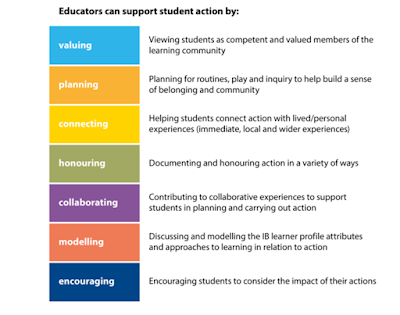
As teachers we play an important role in fostering the agency and skills that enable students to take action that is meaningful to them.  We create a range of indoor and outdoor environments that encourage and support students' interests and emerging identities.  We show them that we value them and see them as competent, and so students feel confident to take action.  

The publication The Early Years in the PYP contains the following table which I think is a great reminder of what educators can do to encourage and support student action in the Early Years.


Photo Credit:  Hai Nguyen Tien on Pixabay

Friday, December 10, 2021

Becoming internationally-minded

I do quite a lot of school visits and one question I'm always interesting in asking Early Years teachers is how they develop international-mindedness in very young learners.  Of course the aim of all IB programmes is for students to develop and demonstrate international mindedness so that they recognise their connections to others, and feel a sense of responsibility for contributing to a better a more peaceful world.  All well and good, but what does this look like in 3-6 year olds?

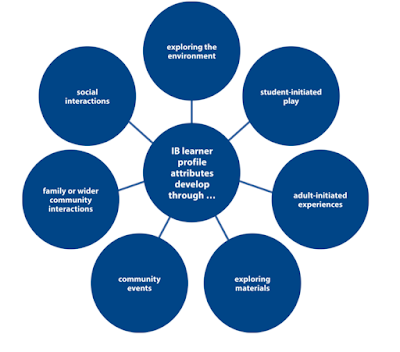
International mindedness is developed through the learner profile attributes and all the attributes can be observed and supported in various ways at any age.  This works best when the language of the attributes is used authentically, for example when talking to children and describing learning through play, and when all members of the learning community model the learner profile.  Further examples can be seen in the diagram below:


During the Early Years students can be encouraged to be agentic and to take ownership of their learning.  This will motivate them to share their ideas an opinions and to notice and reflect on the learner profile attributes that are developing in themselves and their peers.  Learning experiences will give them knowledge, understanding and skills to encourage them to be caring members of their class and school communities.

Play is inquiry

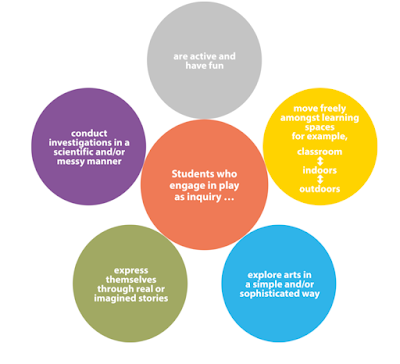
 In recent years there has been more and more emphasis on play in the Early Years setting.  Play is important because it is inquiry in the truest sense.  It is student-initiated and it involves freedom and choice and therefore builds agency and develops skills.  It is through play that children move from dependence to independence through building their self-regulation.   Because of this, Early Years students need extended time for play, and the adults should use this time to monitor and document the learning through inquiry that they observe happening.

There is a multitude of research that points to the development of skills through play, as both cognitive processes and social engagement are activated.  These skills include language, symbolic exploration and expression, literacy and numeracy, all vital for any future learning.  See the diagram below from The Early Years in the PYP publication.


I've visited a number of Early Years settings recently and it has been a real joy to see how these flexible spaces have enabled students to make independent choices about where, what and how they will learn.  In the UK schools I've visited this is known as "continuous provision" and it describes all the areas that the children use each day.  In each area there is a range of resources that are available to students all of the time to encourage them to learn skills while at the same time challenging their thinking and helping them to embed concepts.  The adults observe the children and use what they notice to engage in questioning and learning conversations with the students.  I was interested to read that continuous provision actually goes deeper than provision that is continually accessible - it also involves the selection of resources that continue the provision for learning in the absence of an adult.


Thursday, December 9, 2021

Learner agency in the Early Years

For the past two years all over the world, young children have had a disrupted start to their school life as countries have plunged into lockdown and schools have closed for face to face teaching.  Over and over again I've heard that this has led to a delay in the social and communications skills in Early Years students, but at the same time I've also heard many teachers refer to an increase in learner agency during this period, which I have to admit has been rather a surprise to me.  However, even before they come to school, children develop a strong sense of identity through their interactions with others.  With children, development is not linear, and cognitive, physical, social and emotional development differ greatly from one child to the next.

The PYP refers to the work of Bandura when describing how action will only happen when people believe in their own capabilities - we all need self-efficacy to believe that we can make decisions and take steps to bring about change.  Play is an important way to encourage agency, self-efficacy and self-regulation.  Children begin to built their identities from birth as they interact with their family at home, and they bring their self-concept with them from home to school where they further interact with other adults and children, building their identities through play and interacting with others and the environment.  As agency develops children can start to become more self-directed in their learning and to set their own goals.

In a PYP Early Years setting students are valued as competent learners who actively engage in their learning and who can reflect on this.  Early Years teachers know that it's important to foster relationships and to consider the design of the environment and the curriculum.  This approach is also seen in the Reggio Emilia philosophy which refers to the three teachers - the parent, the teacher and the environment itself.  It is the child's relationship with the parent, teacher and environment that ignites learning.

Learning spaces, therefore, need to be inviting.  They should be flexible, so that they can be transformed in different ways to respond to the children's interests and to encourage them to be active in exploration and discovery.  Observing, monitoring and documenting the ideas, wonderings and theories that emerge can guide the planning of the units of inquiry and the creation or adaptation of learning goals.  Agency can be further fostered through giving access to different materials and encouraging students to make choices and to take risks, and timely feedback that encourages reflection can also play an important role in fostering learner agency in our Early Years students.

Photo Credit:  Prashant Sharma on Pixabay

Laying the foundations for lifelong learning

Last month I led an online Early Years workshop, and shortly after that I started work with another workshop leader to plan a workshop focused on 3-6 year olds.  I've long been fascinated by this age group, though I've worked with them mostly as a single subject teacher and not a homeroom teacher.  As the IB has come out with a new publication entitled The Early Years in the PYP just two months ago, I decided it would be great to dig deep into this and write a series of blog posts focused specifically on these learners.

As many of my readers will know, my first 6 years as a teacher were in secondary school.  It was only after I moved to the International School of Amsterdam, where there were students from aged 3 - 18, that I really experienced Early Years classes.  From my secondary perspective my first reaction was that it was chaos, with students all doing different things and I wondered how the teachers could be monitoring the learning.  However it didn't take me long to realise that designing the learning environment for students was very intentional and that all these experiences strengthened the children's emotional, physical, social and cognitive development.  The children I encountered were all curious and were actively involved in exploring the world around them in order to make meaning of it.  They were wondering and asking questions, trying things out to see what would happen, and building their own theories of the world.  And of course they didn't slot all this learning into "subjects".  The more I looked at students playing, the more I realised how vital this was for all learning, and the more I realised that this was supporting differentiation, as the children all learnt at their own pace.  The children had agency, they were naturally inquisitive and creative, and all this contributed to their development in many areas: language and communication, social skills, thinking skills and self regulation.

Watch this space for further thinking about learning in the Early Years.

Photo Credit: Dana Tentis on Pixabay